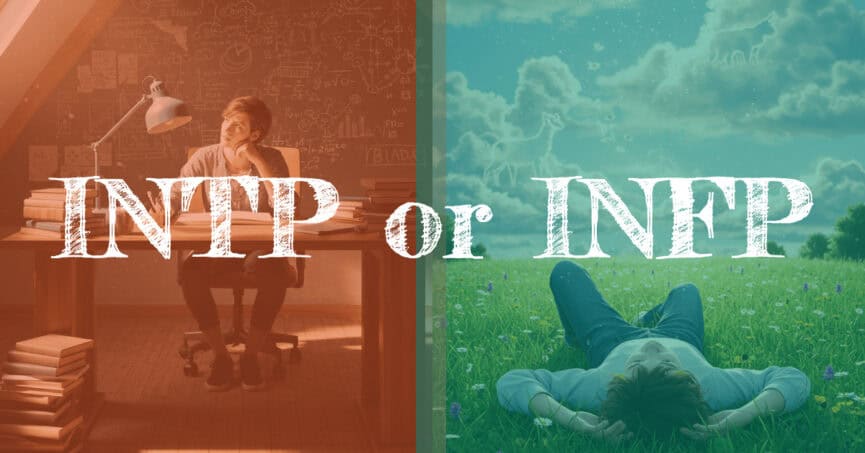
I’m an ENTP. And as a transformation coach and existential counselor, a lot of INTPs and INFPs come to me since I specialize in N types, and—after living most of my life as a strong Thinker type, but having done a huge amount of personal growth work around Feeling—I understand both the T and F worlds.
In my experience, INTP vs. INFP can be one of the most challenging type pairs to differentiate since they share the same middle two cognitive functions (the two functions responsible for gathering information, and the one that makes both types so curious and likely to wander off on tangents).
So, even though INTP and INFP seemingly only have one letter off, they’re actually quite different inside — because of their first and fourth functions: the one they make decisions with, and the one that they’re least skilled with.
The tricky part here is getting past the stereotypes.
- This is not just a question of “are you a head person or a heart person”—that can often be more about your upbringing than your actual brain wiring.
- Gender stereotypes in particular can play a big role here. Female INTPs can get mistyped as INFPs due to expectations about how a woman “should be” warm and not blunt. Similarly, male INFPs can get mistyped as INTPs since they’re not “supposed to be” so emotional.
- Plus, both these types tend to be quiet, curious, dislike being managed, bad at deadlines, and prone to having lots of interests but not actually finishing things.
So, in this post I’ll lay out the differences that should be most likely to help you decide which one you are.
This page is for you if:
- You’ve narrowed your type down to INTP or INFP and keep switching between them
- You test as one but identify with the other
- You’re an “analytical INFP” or a “soft-hearted INTP,” and neither standard description fits you
- You’re trying to better understand a friend, partner, or co-worker who’s one of these
Reading Time: 12 minutes
Are you an INTP or an INFP? What’s the difference?
Remember as you read that nothing is absolute. Your type simply refers to the tendencies you have. There will always be exceptions.
So think about average times and your natural go-to approaches rather than that one time you did something out of character.
Try to think about how you were as a kid—before parents, teachers, friends, movies, or whatever else told you that you should be a certain way. Who are you deep down at your core?
(And recognize that, due to trauma and all sorts of messaging we received from the external world, many of us learned to cover up who we really were to try to stay safe or look appealing to others.)
One more caveat: This whole post compares INTPs and INFPs against each other—not to other types. When I say INTPs are less interested in ethics, I mean less than INFPs, who are extreme about it. Next to an ESTP, in contrast, your average INTP might seem completely fascinated by ethics.
Make sense? Here we go:
How they process the world
| INTP |
INFP |
- “Is this true? Is this correct? Does it rationally make sense? What exactly do you mean by that?”
- Judges according to logical consistency (not just pure “objective correctness,” but more of a private internal model of how things work that they’ve developed over many years)
- Willing to argue a perspective they don’t believe in just to explore it
- An INTP’s sense of self is looser. If you ask them about themselves, they’re likely to reply with a list of things they know or believe
|
- “Is this right? Does this sit well with me? Is this who I am (or who I want to be)?”
- Judges according to an internal sense of value and significance (which can be just as precise and nuanced as the evaluation of an INTP, just along a different metric)
- Much less willing to argue a perspective they find distasteful since it would be betraying themselves
- An INFP’s sense of who they are is fundamentally important to them, and they’re very careful to stay faithful to what feels real and important to them
|
Careful: Both types have a private internal standard they might not be able to fully explain. And both types can be stubborn, holding to that internal sense of correctness or rightness even under social pressure. This is one reason the two types get mixed up—both have a strong inner compass, but the compasses are moving according to two slightly different metrics: correctness versus rightness.
Their inner emotional life
| INTP |
INFP |
- INTPs can have strong inner emotional lives too, but it can be difficult for them to access it with precision
- They might feel something but be unable to name it, or they much just have a sense that something is off (or they feel restless, stuck, etc.), and they only realize hours or days later what they were actually feeling
- They might also just feel something intense or overwhelming without being able to split it apart into specific emotions
- INTPs tend to think of their emotions as a problem to solve or a puzzle to figure out
|
- INFPs tend to be able to easily access their emotional worlds and to navigate with precision
- They can often skillfully distinguish between various flavors or shades of feeling—to feel the texture and slowly unpack the components in real-time
- The harder part for INFPs tends to be getting out of that rich internal world. They might remain in that feelings investigation long past the point where they’re still getting new valuable information
- INFPs tend to think of their emotions as very important information (which is often accurate but again, can sometimes be something they get too caught up in)
|
Careful: INTPs can become quite articulate about emotions as well. After all, they love learning, and they enjoy systems thinking. Emotional intelligence is a skill that can be developed, so an INTP who’s worked hard at it might be more emotionally skillful than an INFP who hasn’t. Also, both types can be quite sentimental and oriented toward familiar, emotionally-loaded, nostalgic things.
How they argue, and what hurts most
| INTP |
INFP |
- Enjoys debate and intellectual argument
- Says they enjoy being proven wrong (and they do), but they can still feel an emotional sting
- More likely to correct the terms being used (“that’s not what that means”)
- Feels more hurt if they’re called stupid, sloppy, or naive
- Finds it strange that people aren’t willing to change their minds when new information is revealed, or that other people take it personally if they’re proven wrong
- The worst thing would be being wrong in a way that others realized but they didn’t
|
- Doesn’t tend to enjoy debate just for the sake of it, though they can definitely enjoy intellectual conversation
- They might push back, or they might agree on the surface but keep holding strong to their opinion inside
- More likely to correct a characterization (“that’s not what I meant” or “that’s not why I did that”)
- Feels more hurt if their motives are misunderstood or if they’re called selfish, fake, or hypocritical
- Finds it strange that people aren’t willing to stand up for their values more, or that they’re so focused on debating facts rather than the worldview or value system behind them
- The worst thing would be being bad or unethical without realizing it
|
Ethics, and moral clarity
| INTP |
INFP |
- Ethics are interesting (trolley problem, etc.)
- They can be suspicious of moral certainty, and they won’t necessarily treat ethical problems as more important than others
- Can have firm values (often around honesty, intellectual freedom, truth, etc.), but less likely to build their life around a cause (and if they do, it’ll be a cause they can intellectually defend from first principles)
|
- Ethics aren’t just interesting—they’re foundational to life
- Moral clarity can arrive fast and without a need for justification (they just know)
- They’re more likely to commit to a cause and restructure their life around it, even losing friends if necessary
|
Careful: It’s not that INFPs are the moral ones and INTPs don’t care. INTPs can be very willing to fight for something they believe in, but the “belief” will have been reached differently—more from step-by-step logic, versus the INFP who simply felt the rightness or wrongness of it.
Structure, stress, and relationships
| INTP |
INFP |
- Procrastinates on aspects of the project that involve other people or asking for help
- Wants to be liked, but getting that can feel confusing since they can be hypersensitive to what other people think of them (so, they might opt out of socializing to avoid having to figure that out)
- Resists structure because it feels confining
- Works on building something amazing but doesn’t show anyone until it’s just right… which might be never
- “Nobody actually likes me, and I feel emotionally flooded but I can’t explain it”
- If you tell them you’re struggling, they’ll try to diagnose the cause and fix it (and they might find it confusing and unfair if you don’t want that)
- Intimacy feels like being understood
|
- Procrastinates on aspects of the project that involve logistics, deadlines, structure, metrics
- Wants to be effective, but getting that can be confusing since they can feel coldly critical of themselves (so, they can go back and forth between relying on no systems and building elaborate ones)
- Resists structure because it feels inauthentic
- Works on building something amazing but doesn’t know where to put it or how to show it off
- “I’m useless, I keep wasting my life, everyone else is further ahead”
- If you tell them you’re struggling, they’ll try to empathize by feeling what you’re feeling and standing by your side (and they might feel hurt if you don’t think that’s valuable)
- Intimacy feels like being accepted unmasked and unedited
|
Common areas for growth
| INTP |
INFP |
- Analysis paralysis, and imagining that all decisions have a “correct” answer
- Avoiding emotions and calling it rationality
- Discounting how much they need other people, and telling themselves they enjoy isolation when (some of) it might be social anxiety
- Not finishing things because of perfectionism or too many new additions and refinements
|
- Idealization of what a person, situation, or relationship could become instead of being with what it actually is now
- Staying too long in a relationship or situation that should have already ended, or confusing intensity of feeling with good judgment
- Avoiding any kind of structure until things begin falling apart and it becomes necessary
- Waiting too long to “feel ready” for something
|
Famous people of each type
| INTP |
INFP |
- Albert Einstein
- Sherlock Holmes
- Lisa Simpson (The Simpsons)
- Velma Dinkley (Scooby-Doo)
|
- Johnny Depp
- A. A. Milne (creator of Winnie-the-Pooh)
- Björk
- Frodo Baggins (Lord of the Rings)
|
Still not sure?
Which of these sound more like you?
- Can you argue a position you find repellent just for fun? Or, do you find yourself correcting someone’s word usage? (Both are more INTP)
- Which hurts more? “You’re not as smart as you think you are” (more INTP) or “You’re not as good a person as you think you are” (more INFP)?
- If a friend is struggling, do you immediately gravitate toward figuring out what actually happened and why (more INTP) or figuring out how they felt (more INFP)?
- When you’re upset, are you drawn more toward explaining it (more INTP) or expressing it (more INFP)?
- Is there a cause important enough to you that you’d lose a friendship over it? (more INFP)
Ok, so what? What should you do now that you know your type?
Finding your true type is important, but it’s just the first step. I’m a big believer in actually putting that knowledge into practice to improve your life—to increase your self-awareness and take active steps toward overcoming the barriers you face in living the most fulfilling life possible for yourself.
Here are some next steps I suggest:
- If you’d like support customized for you, INTPs and INFPs are some of the types I most commonly work with as a transformation coach and existential counselor. I help people like you deal with overthinking and procrastination so you can actually take action; set better boundaries and put your needs first; improve your confidence; and more.
- Become full-stack human to transform your life and unlock your full potential.
- I’d love to hear how this post landed with you. Please leave a comment below or feel free to ask a question.
- Check out my new YouTube channel where I speak at the intersection of psychology, typology, rational spirituality / existential questioning, and deep personal growth.